
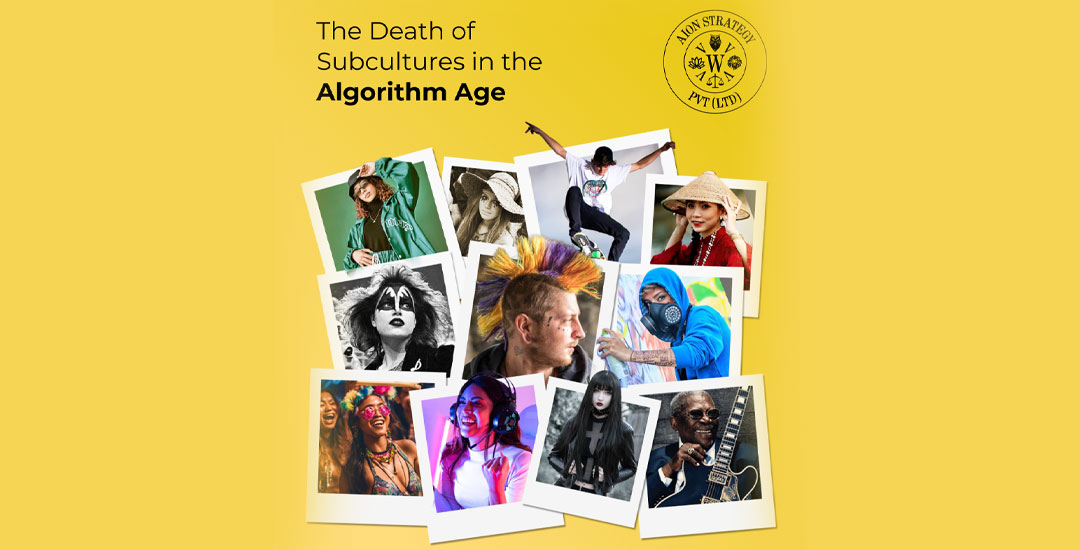
For decades, subcultures emerged through discovery.
Through exploration. Form. Geometry. Sound. Symbolism. Adventure. Experimentation. Rebellion. Defiance. Resistance. Persistence. Perseverance. Invention. Cultural integration. Revolution.
There was a time when belonging to a subculture meant something.
You had to search for it. Travel for it. Buy the magazines. Own a tape. Belong to an exclusive club with kindred spirits. Have a near occult obsession. Attend the shows. Stand in sun, snow, and rain. Meet people and engage. Learn the codes. You were creating identity around cultural nuance. Building your identity around the thing you loved. You were participating in meaning-making that is tribalistic. Authentic. Intuitive. In its truest, barest form. You actually belonged, and were a part of something larger than life itself.
Enter the modern contrast. The new age dynamic.
Today, culture arrives pre-packaged, processed, and ready for mass consumption.
Curated. Recommended. Optimised. Delivered.
Not through communities. Not through tribalistic connections. Not through belonging to a cause, an ideology, a lifestyle.
But through algorithms.
Historically subcultures were built through:
- Physical spaces
- Shared experiences
- Collective identity
- Participation
Now, algorithms turn communities into ready-made audiences. Individualisation is algorithmic dependency in the shape of dopamine addiction.
The distinction is important.
A community contributes. An audience consumes.
And the more we feed them what they want, the more they need to consume.
It’s true that there used to be a kind of mania to becoming acclimated into a sub-culture. People had their idiosyncrasies. Their obsessions. Their unique tropes and attributes. But it was a real deal. You were still independent. And one could argue that your thoughts no matter how dangerous for the most part – were your own. If you decided to immerse yourself and become a part of an ethos. You had to seek it out, and clock-in the time and effort to be recognised as someone worthy to be a part of it.
People sought out their sub-cultures by ingraining and embedding it into their lives, their minds, their souls. They invested time. They learned the language. The symbols. The values. The music. The fashion. The philosophy.
Blues.
Punk.
Metal.
Hip Hop.
Skateboarding.
Goth.
Rave.
Gaming.
Underground art scenes.
Each required participation. Each required commitment. Each required belonging.
Today, algorithms have changed that relationship.
Instead of people discovering culture… Culture is increasingly discovering people.
This is where it gets interesting. Algorithms no longer gather people around shared identities. They build personalised realities. Life is increasingly imitating technology. We have forgotten which came first.
Everyone gets an influx of different content, different creators, different trends, different narratives – but with a dangerous familiarity and similarity of content cannibalism where choice is no longer in our hands.
What we desire, seemingly love, and consume is being systematically chosen for us.
We are no longer experiencing culture together.
We are experiencing customised versions of it.
That changes social cohesion. It disintegrates identity formation. It shatters individuation.
Many subcultures once represented resistance, ideology, values, belonging.
Today they often become aesthetics. People consume the aesthetics without truly understanding the nucleus of what they embrace. Goth aesthetics. Punk aesthetics. Wellness aesthetics. Mind-set aesthetics. Activism aesthetics.
People are sipping water without noticing the spring. We are all partaking without being a part of anything meaningful and sincere. We are happy to consume without necessarily participating in the underlying culture.
The algorithm rewards appearance. Not commitment.
Visibility. Not belonging.
Performance. Not participation.
Brands have noticed this. Businesses have identified this. Many no longer build tribes. They build temporary micro-trends by macro-obsessions.
Algorithms are relentless in feeding us what we desire, often without considering the long-term consequences. Humans are reduced to mere metrics. Just instruments to be measured, quantified, categorised, labelled, and experimented on. Algorithms after all reward novelty. Not loyalty.
The result?
The modern consumers are highly connected, highly visible, validated by perfect strangers around the world – yet increasingly disconnected from genuine communities. Increasingly disconnected from one another. It is possible to exist without truly living.
Humans evolved through belonging. Through connection. Through acute realisation that the only way to steer the ship to the shore safely is sometimes to face the greatest storms. Through trials and error. Burned by fire, frozen by ice. Through adapting to nature. Through cycles. Sound. Rhythm. We are the marvellous amalgamation of sacrifice, struggle, survival. We have risen and fallen with the civilisations we once chiselled. Gripping unto science, clutching onto art. By putting our minds through unbelievable hardship. Our bodies through pain and process to learn. Tribes. Groups. Shared stories. Collective identity. These are the things that frame culture. What gives it wings.
Yet modern technology increasingly individualises culture.
Ironically, we have never been more connected with each other than ever before. And yet we have never been a species more isolated, boxed-in, and detached from each other at the same time.
Loneliness continues to rise globally. That tension is worth noticing.
Subcultures are dead.
Well, that isn’t entirely true.
Subcultures still exist.
But they are fighting against systems designed to compress difference into engagement metrics. So, the real, relevant question is not whether subcultures can survive. The question is whether meaningful belonging can survive in a world increasingly optimised for consumption.
Perhaps we must forge a new synthesis as we carry new ideologies, systems, and truths forward into the future.
Maybe, there will be rebellion. Revolution. Restitution.
Not without a cost.
If we allow algorithms and the companies that play God, judge, and jury with human lives to dictate what we crave, how much, when, and where… well then, it will only be a matter of time before we are also told who we are as well.
How long before the algorithms demand ‘jump’ and we ask ‘how high?’
Our true worth should never be measured by algorithms.
Perhaps it’s time to fight for individuality. Community. Tribality. Our humanity.
Are we using the algorithms to fulfil our wants and needs, or are the algorithms using us?
